
Cold From Kashmir To The Plains; Snow In Saudi Arabia; El Niño In 2026, Then Resumed Cooling; New Study: Antarctic Sea Level Once 30 Meters Higher; + Conflict-Of-Interest In Climate Lawsuits
Cold From Kashmir To The Plains
Cold is spreading across India, with deep freezes in the north and unusually persistent chills reaching central regions.
In Jammu and Kashmir, Zojila Pass plunged to -17C (1F), the coldest reading in the region. Much of the Kashmir Valley fell below freezing, with Awantipora seeing -3.8C (25F), Pulwama -3.2C (26F), and Pampore and Baramulla -1.8C (29F).
Freezing lows extended across Kupwara, Budgam, Bandipora, and Ganderbal, confirming a widespread cold wave.
Further south, Pune has recorded its coldest first half of December in at least 12 years. From December 1 to 15, the city’s average minimum fell to 10.66C (51F), with a full week holding below 10C (50F) — a frequency not seen in decades.
Meteorologists cite persistent northerly flow, very dry air, and clear skies driving strong radiational cooling.
Snow In Saudi Arabia
Looking west, the chill extends into the Arabian Peninsula.
Saudi Arabia is enduring a rare wintry blast, with rare settling snow reported in Ha’il during the early hours of Dec 18:
Snowing in Hail, Saudi Arabia tonight ❄️☃️❄️pic.twitter.com/hmMwl4irtC
— Volcaholic 🌋 (@volcaholic1) December 17, 2025
Snow events such as this are usually confined to Saudi Arabia’s higher elevations further north or southwest, not interior desert cities like Ha’il.
Hail, Kingdom of Saudi Arabia ❄️ pic.twitter.com/Vh6bdz2hlh
— Nouf..🇸🇦 (@Hail20207) December 18, 2025
From the Himalayas to the Deccan Plateau and into the deserts of Arabia, cold is asserting itself across a wide swath of the region.
El Niño In 2026, Then Resumed Cooling
ECMWF’s latest Niño 3.4 ensemble indicates a moderate El Niño in 2026, with peak sea-surface temperature anomalies near +1C. That aligns with the 2018 event and would hold well below the strong El Niños of 2016, 2024, and 2009…
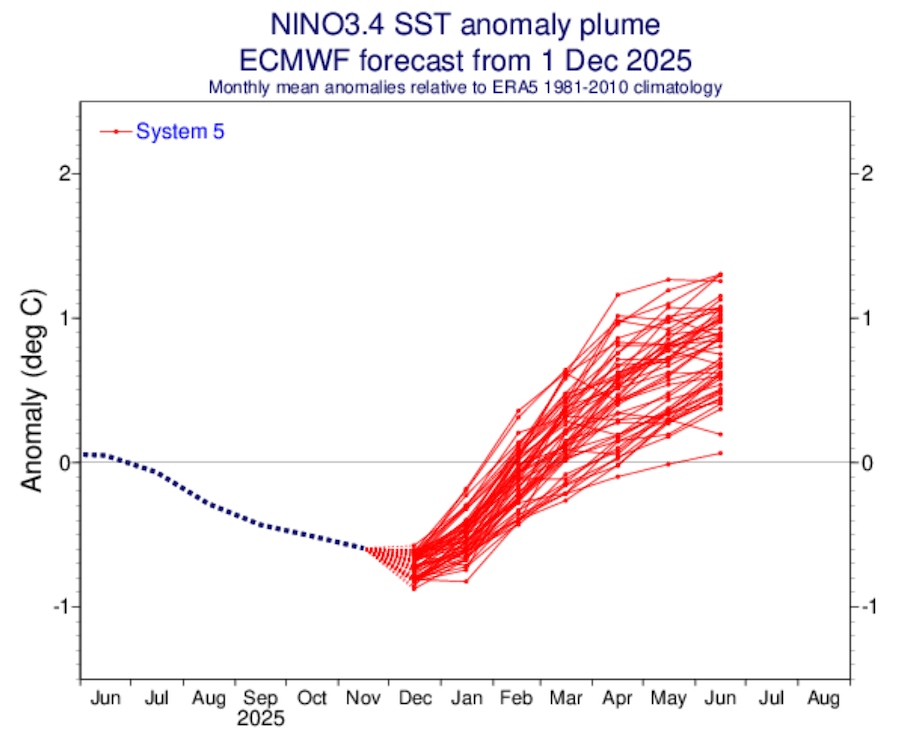
Climate researcher Javier Vinós notes that a +1C Niño, if it plays out, would be a weak warming signal that won’t override the broader cooling forces currently acting on the climate system, particularly as solar activity continues its decline.
A weak to moderate El Niño layered onto this background does not change the dominant energy balance.
According to Vinós, the climate will continue moving deeper into a weaker solar phase, with global cooling likely to resume after this upcoming El Niño fades, extending toward the next solar minimum around 2030.
New Study: Antarctic Sea Level Once 30 Meters Higher
A new study finds that relative sea level in parts of East Antarctica stood roughly 30 meters (98 feet) higher than today around 8,000 years ago.
Researchers reconstructed past sea levels using raised shorelines, isolation basins, and abandoned penguin rookeries. These natural markers show when land shifted from marine to dry conditions, allowing sea level change to be dated with radiocarbon methods.
After peaking around 8,000 years ago, sea level fell rapidly and persistently.
By 7,200 years ago, sea level had already dropped to about 24 meters (79 feet) above present. By 5,700 years ago, it had fallen further to roughly 15 meters (49 feet). By 800 years ago, it was still 1 meter (3 feet) higher than today.
The authors found sea level fell at roughly 10 meters (33 feet) per thousand years between 8,000 and 6,000 years ago, before slowing to around 4 meters (13 feet) per thousand years from roughly 6,000 years ago to very recently.
This was not driven solely by ice melt raising the oceans. The dominant process here was land rebound. Because ice is extremely heavy, it pushes the Earth’s crust downward; when that ice retreated after the last glacial period, the crust beneath East Antarctica rebounded upward. The land moved up, so relative sea level fell.
East Antarctica has undergone large, rapid, natural sea-level swings during the Holocene — without human influence.
Conflict-Of-Interest In Climate Lawsuits
Climate scientists accused of working with fossil fuel companies are publicly attacked as conflicted. Scientists who work directly for climate law firms and advocacy groups currently face little, if any scrutiny.
Court filings in County of Multnomah v. Exxon Mobil now place that imbalance under the spotlight.
According to the filings, a lawyer representing climate plaintiffs partially funded an academic wildfire attribution study. That same study was later used in court by one of the plaintiffs’ expert witnesses to support claims of climate-related damages. The funding link between the lawyer and the study was not disclosed in the expert report or in the plaintiff’s court filings.
The filings also show that academics often play multiple roles in climate litigation.
They publish attribution studies, act as expert witnesses, write opinion pieces supporting lawsuits, and work with organizations whose stated goal is to pursue climate liability cases. And it doesn’t stop there. These same academics also help produce training materials used to “educate” judges on climate issues. Court filings show that draft versions of those materials were edited before release and that a plaintiff-side lawyer had access to marked-up drafts. The filings argue that it is unclear who shared the drafts, who influenced the edits, or why content flagged as irrelevant by the author ended up in the final version shown to judges.
Plaintiffs argue that peer review guarantees independence. The filings dispute this, revealing that peer reviewers are themselves affiliated with climate litigation NGOs or advocacy groups aligned with plaintiffs.
The same network produces the studies, reviews them, testifies from them, and promotes them to courts.
Defendants are now seeking evidentiary hearings and limited discovery. Their argument is straightforward: without full disclosure of funding, coordination, and overlapping roles, judges cannot properly assess the credibility of “expert” evidence.


From one extreme to another. Earlier this month we were getting hit with M and X class flares right and left. Now it’s B’s and C’s.
What a rat’s nest of legal malpractice! Furthermore, I imagine the climate lawyers are adept at “judge shopping” and occasionally finding a judge who is already quite sympathetic to the position of the climate case.
Google AEye says: “An ancient, massive underwater stone structure, potentially a 7,000-year-old wall or fish trap, has been discovered off the coast of Brittany, France, near the Ile de Sein, sparking renewed interest in the legend of the mythical sunken city of Ys (or Ker-Is), with archaeologists believing this find could be the real-world origin of the myth, a testament to a sophisticated Stone Age society that disappeared as sea levels rose.”
Sea levels didn’t drop at all: as you said, Antarctic rose as the ice melted.